Continuous integration and continuous delivery should be the backbone of your software delivery process. When it works, teams ship multiple times per day without thinking about it. When it does not, every release becomes a risky, stressful event that everyone avoids.
If you want to understand the technical implementation - pipeline stages, environment promotion, and deployment strategies - see our continuous delivery on AWS implementation guide.
This post covers what CI/CD consulting services actually include, the problems we solve, and how to know when it is time to bring in a CI/CD consultant. Whether you call it continuous integration consulting, continuous delivery consulting, or pipeline consulting, the goal is the same: reliable, automated releases your team trusts. If you already know you need help and want to see scope, pricing, and engagement structure, go directly to our CI/CD consulting services page.
What CI/CD consulting actually includes
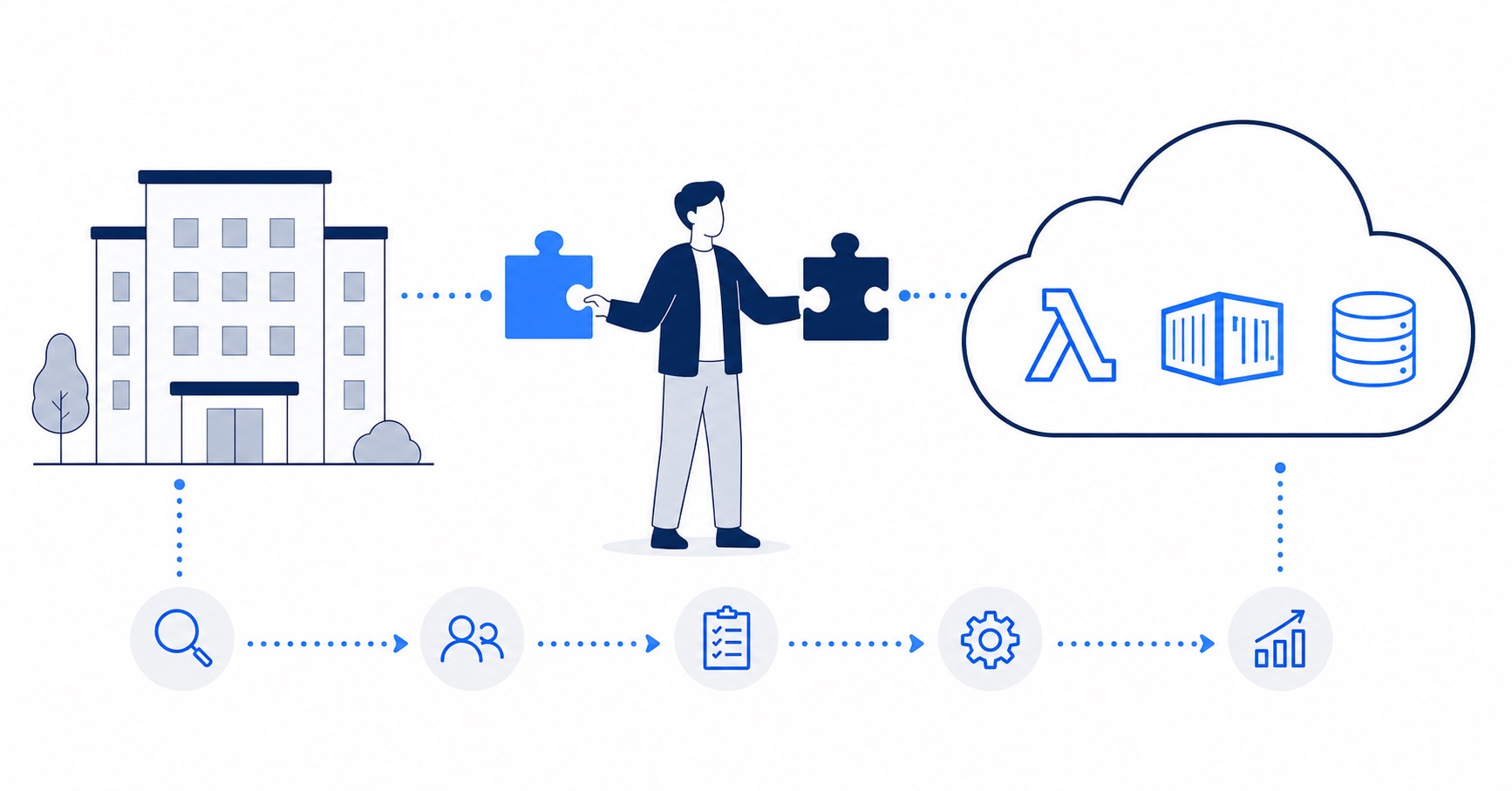
CI/CD consulting is not just “setting up GitHub Actions.” It is a structured process that takes your team from unreliable, manual releases to automated, repeatable deployments with confidence. Here is what a proper engagement covers:
Pipeline audit. We review your existing CI/CD setup - or lack of one. Where are the bottlenecks? What fails silently? What is the actual time from commit to production? We document the current state before proposing changes.
Pipeline design. Based on the audit, we design a pipeline architecture that fits your team, your codebase, and your deployment targets. This includes branching strategy, environment promotion paths, testing stages, and approval gates.
Implementation. We build the pipelines in your repository using your team’s preferred tooling. Every workflow file, every configuration, every secret management setup - committed to your repo as code that your team can maintain.
Security hardening. Secrets management, OIDC authentication (no long-lived credentials), dependency scanning, container image scanning, signed commits, and least-privilege access. Security is not a bolt-on step. It is built into the pipeline from day one.
Handover and documentation. Runbooks for common operations. Architecture decision records explaining why we chose specific patterns. Knowledge transfer sessions so your team is self-sufficient after the engagement.
Common CI/CD problems we solve
These are the issues we see most often when teams reach out for continuous integration consulting:
- Builds that take 15+ minutes. Developers stop running them locally. PRs stack up waiting for CI. Feedback loops stretch from minutes to hours.
- No staging deployments. Code goes from a developer’s laptop to production with nothing in between. Or staging exists but is never updated.
- Manual release processes. Someone SSHs into a server. Someone clicks buttons in the AWS console. Someone runs a script from their local machine that only they have.
- Flaky tests. The test suite passes 80% of the time. Teams learn to “just re-run it” instead of fixing the root cause. Trust in the pipeline erodes.
- No rollback strategy. When a deployment fails, the recovery plan is “revert the commit and pray.” No blue-green. No canary. No automated rollback.
- Secrets in plaintext. API keys in environment variables committed to Git. AWS credentials hardcoded in pipeline files. Tokens shared in Slack messages.
If more than two of these apply to your team, CI/CD consulting will pay for itself within the first month through reduced deployment risk and recovered engineering time.
When to hire a CI/CD consultant
Not every team needs external help with their pipelines. Here are the signs that indicate it is time to bring in a specialist:
Manual deploys are still the norm. If releasing requires a specific person to run a sequence of commands, your bus factor is one and your deployment frequency is artificially limited.
Friday releases terrify your team. If the phrase “let’s wait until Monday” is your deployment policy, your pipeline does not provide enough confidence for safe releases at any time.
“It works on my machine.” If there is a meaningful gap between local development environments and CI, you are burning time on environment-specific bugs that should not exist.
No deployment audit trail. If nobody can tell you what version is running in production, who deployed it, and when - you have a compliance and operational visibility gap.
Your team builds product, not pipelines. Your developers are excellent at application code but nobody has deep expertise in CI/CD tooling, container orchestration, or deployment automation. That is fine. It is a specialisation.
You are scaling and the current approach does not hold. What worked for 3 developers and weekly releases collapses at 15 developers and daily releases. Pipeline architecture needs to scale with the team.
CI/CD tool selection - how we decide
One of the most common questions in CI/CD consulting is “which tool should we use?” The answer depends on context, not marketing. Here is how we evaluate options:
GitHub Actions - our default recommendation for teams already on GitHub. Native integration, strong marketplace ecosystem, excellent for container workloads, and generous free tier for open-source. Best for: most teams, especially those shipping containers to AWS.
GitLab CI - if you are on GitLab for source control, use GitLab CI. The tight integration between merge requests, environments, and pipelines is hard to replicate with external tools. Best for: teams committed to the GitLab ecosystem.
AWS CodePipeline + CodeBuild - makes sense for teams with strict compliance requirements that mandate everything stays within AWS boundaries. More verbose to configure than GitHub Actions but integrates natively with IAM and other AWS services. Best for: regulated industries with AWS-only mandates.
Jenkins - we rarely recommend new Jenkins installations. If you have an existing Jenkins setup that works, we will optimise it. But for greenfield projects, the operational overhead of self-hosting Jenkins is not justified when managed alternatives exist.
Decision factors we weigh:
- Where does your source code live?
- What cloud provider do you deploy to?
- Does your security team mandate specific tool boundaries?
- What is your team’s existing experience?
- How much operational overhead are you willing to accept?
The right tool is the one your team will actually maintain. We optimise for long-term sustainability, not conference-talk architecture.
What a typical CI/CD consulting engagement looks like
Our CI/CD consulting engagements follow a predictable structure. The scope varies, but the phases are consistent:
Week 1: Audit
- Review existing pipelines, scripts, and deployment processes
- Interview developers about pain points and workflow friction
- Measure current metrics: build time, deployment frequency, failure rate, recovery time
- Document findings and prioritised recommendations
Weeks 2-3: Design and implementation
- Design pipeline architecture based on audit findings
- Implement CI pipelines: build, test, lint, security scan
- Implement CD pipelines: staging deployment, production deployment, rollback
- Configure secret management (OIDC, vault integration, or platform-native)
- Set up environment promotion: dev to staging to production
Week 4: Testing and handover
- Run the new pipelines through real deployment cycles
- Fix edge cases and refine trigger conditions
- Write documentation and runbooks
- Conduct knowledge transfer sessions with the team
- Provide a post-engagement support window for questions
For larger teams or complex architectures (monorepos, multi-service deployments, multi-cloud), the engagement extends to 6-8 weeks. For a single-service application with straightforward deployment needs, 2-3 weeks is often sufficient.
CI/CD patterns we implement
Every pipeline we build follows proven patterns. These are not theoretical - they are what we ship for production workloads:
Trunk-based development. Short-lived feature branches merged frequently to main. CI runs on every push. No long-lived branches that drift and create painful merge conflicts.
Environment promotion. Code flows through defined stages: build, test, deploy to staging, run integration tests, deploy to production. Each stage gates the next. No skipping.
Blue-green and canary deployments. For services where zero-downtime is critical, we configure traffic shifting so new versions receive a small percentage of traffic before full rollout. Automated rollback if error rates spike.
Infrastructure as Code pipeline. Terraform changes go through the same CI/CD process as application code. Plan on PR, apply on merge. No manual terraform apply from anyone’s laptop.
Container build pipelines. Multi-stage Docker builds, layer caching, vulnerability scanning, image signing, and push to ECR or your registry of choice. Build once, deploy the same artefact to every environment.
Dependency and security scanning. Automated checks for vulnerable dependencies, container image CVEs, and infrastructure misconfigurations - integrated into the PR workflow so issues are caught before merge.
How we can help
Devopsity delivers CI/CD consulting as a focused engagement or as part of a broader DevOps consulting project. Our CI/CD services cover pipeline design, implementation, and ongoing optimisation for teams shipping to AWS, GCP, or hybrid environments.
We work primarily with GitHub Actions and Terraform, though we support GitLab CI, AWS CodePipeline, and ArgoCD where the context demands it. Every pipeline we build is committed to your repository as code - no proprietary tooling, no vendor lock-in.
If your team is spending more time fighting deployments than shipping features, a structured CI/CD consulting engagement will get you to reliable, automated releases within weeks - not months.

Ready to fix your CI/CD?
Book a free 30-minute call to discuss your pipeline challenges. No pitch - just a technical conversation about what you need.
Frequently asked questions
How much does CI/CD consulting cost?
A focused pipeline audit starts from EUR 480 (approx. USD 520 / GBP 410) for 8 hours. Full implementation engagements of 3-4 weeks typically range from EUR 3,000 to EUR 6,000 (approx. USD 3,250-6,500 / GBP 2,600-5,200) depending on complexity and the number of services. Prices are shown with USD and GBP equivalents so you can read them in whichever currency fits your market; we invoice in EUR. Ongoing pipeline maintenance is available as part of a cloud support retainer.
How long does a CI/CD consulting engagement take?
A pipeline audit takes 3-5 days. Design and implementation for a single-service application takes 2-3 weeks. Complex setups (monorepos, multi-service, multi-environment) take 4-8 weeks. Most teams see measurable improvement within the first week of implementation.
Which CI/CD tools do you work with?
Primarily GitHub Actions and AWS CodeBuild. We also support GitLab CI, AWS CodePipeline, ArgoCD, and Bitbucket Pipelines. The choice depends on where your code lives, where you deploy, and what your team already knows.
Do you provide ongoing CI/CD support after the engagement?
Yes. Many engagements transition into a maintenance retainer where we handle pipeline updates, dependency upgrades, and new service onboarding. See our cloud retainer post for details.
Can you improve our existing pipelines without rebuilding from scratch?
Absolutely. Most engagements start with optimising what exists rather than replacing it. We reduce build times, add missing security scanning, fix secret management, and add deployment stages incrementally. A full rewrite is only necessary when the existing setup is fundamentally broken.