This post explains what AWS DevOps consulting services include, how engagements are structured, and how to evaluate a partner. Based on how we deliver at Devopsity. Not theory, but a practical walkthrough from first call to handover.
What AWS DevOps consulting covers
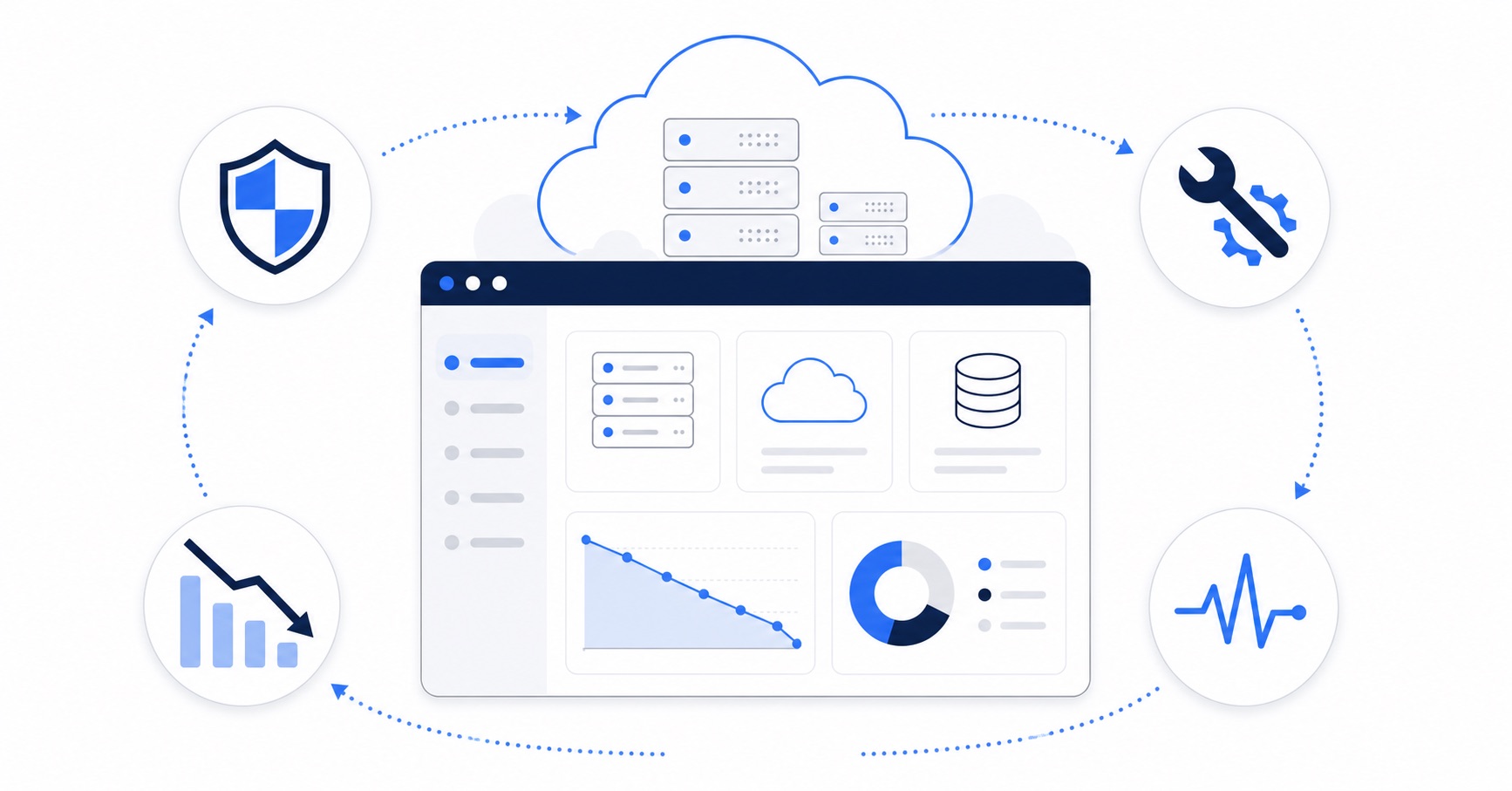
Here is what those five service areas look like in practice.
1. Strategy and assessment
Every engagement starts with understanding where you are today: reviewing your current AWS environment, identifying architectural risks, mapping cost drivers, and producing a prioritised roadmap. For some teams the assessment itself is the deliverable. For others it is the starting point for implementation.
2. AWS architecture and Infrastructure as Code
Architecture design, Infrastructure as Code, and deployment automation are delivered together. Account strategy, networking, compute platform selection, database architecture, and CI/CD pipelines, all codified in Terraform or Terragrunt, version-controlled, and deployed through automated pipelines with testing, security scanning, and rollback mechanisms.
3. Migration and modernisation
Moving workloads from on-premise data centres, legacy hosting, Heroku, DigitalOcean, or another cloud provider into a production-grade AWS environment. This covers target-state architecture, containerisation, data migration, DNS cutover with minimal downtime, and post-migration stabilisation.
See our Heroku to AWS migration case study for a practical example, and our AWS migration costs and process guide for a detailed breakdown of what the project looks like.
4. Security and compliance
Security boundaries, least-privilege IAM, encryption at rest and in transit, network isolation, and vulnerability scanning built into CI/CD. Delivered as a core part of every engagement. For regulated industries this extends to compliance readiness for SOC 2, ISO 27001, and Cyber Essentials Plus.
5. Ongoing support and optimisation
AWS DevOps consulting does not have to end at handover. After the initial build, consulting can continue with regular infrastructure reviews, security hardening, cloud cost checks, and iterative architecture improvements as your product and traffic evolve.
Not every engagement touches all five areas. Most start with one or two and expand based on what the initial assessment reveals.
Who AWS DevOps consulting is for
AWS DevOps consulting is a good fit for teams that build software but lack dedicated infrastructure expertise. Common triggers include an AWS migration on the horizon, a SOC 2 or ISO 27001 deadline approaching, cloud costs outpacing growth, or developers shipping features while nobody owns Terraform, security, or monitoring.
What you get: concrete deliverables
An AWS DevOps consulting engagement produces tangible outputs your team can operate and build on:
- Assessment findings and prioritised roadmap: architectural risks, cost drivers, and a ranked action plan
- Terraform/Terragrunt modules: production-ready IaC for your entire AWS environment
- CI/CD pipelines: automated deployment with testing, approval gates, and rollback
- Security controls: IAM policies, encryption, network isolation, compliance-aligned logging
- Architecture documentation: diagrams, decision records, and operational runbooks
- Knowledge transfer sessions: so your team can operate independently from day one
How a typical engagement unfolds
Every AWS DevOps consulting engagement we deliver follows a similar pattern. The phases adapt to the project, but the structure is consistent.
Phase 1: Discovery (1-2 days)
A technical conversation about your current infrastructure, the problem you are trying to solve, team capacity, and constraints (timeline, budget, compliance deadlines). After this call we provide a proposal with scope, timeline, and cost.
Phase 2: Assessment (3-5 days)
We review your current AWS environment (account structure, security posture, and delivery pipelines) and produce a findings document with prioritised recommendations. This becomes the roadmap for implementation.
Phase 3: Implementation (2-8 weeks)
This is where the work happens. We build, configure, and deploy based on the assessment findings and agreed priorities. Typical implementation work:
- Writing Terraform modules for your infrastructure
- Setting up multi-account structure with proper isolation
- Building CI/CD pipelines with testing and security scanning
- Configuring monitoring, alerting, and dashboards
- Implementing security controls (IAM, encryption, network policies)
- Migrating workloads if the engagement includes a migration
All work happens in your repositories, your AWS accounts, using your team’s tooling where possible. We do not build in isolation and hand over a black box. Your developers can see every commit, review every pull request, and learn from the implementation as it progresses.
Phase 4: Handover (3-5 days)
Every engagement ends with architecture documentation, operational runbooks, knowledge transfer sessions, and a summary of next priorities. The goal is your team operating confidently from day one. If ongoing support makes sense, the engagement can transition into a maintenance retainer.
What outcomes to expect
Real outcomes from recent AWS DevOps consulting engagements we have delivered:
- 40-60% cost reduction through rightsizing, Reserved Instance optimisation, and architecture changes. See our cloud cost optimisation case study.
- Deployment time from hours to minutes by rebuilding manual deployment processes into automated CI/CD pipelines.
- Compliance readiness for SOC 2, ISO 27001, Cyber Essentials Plus through security architecture and automated controls. See our fintech security modernisation case study.
- Migration from legacy platforms (Heroku, DigitalOcean, on-premise) to production-grade AWS with full IaC. See our Heroku to AWS case study.
- Infrastructure reproducibility by codifying everything in Terraform so environments can be rebuilt in minutes rather than days.
The common thread: teams move from a fragile, manually-managed state to an automated, documented, secure infrastructure that the team can operate without external dependency.
How to evaluate an AWS DevOps consulting partner
Not all consulting is equal. Here is what to look for when evaluating a partner for AWS infrastructure work:
Certifications that matter
- AWS Partner status (Select, Advanced, or Premier Tier) confirms the firm has passed AWS’s technical validation and delivered real projects on the platform.
- AWS Solutions Architect Professional means the engineers can design complex architectures, not just follow tutorials.
- AWS DevOps Engineer Professional confirms experience with CI/CD, automation, and operational excellence on AWS.
- AWS Security Specialty is important if compliance or security hardening is in scope.
Certifications alone do not guarantee quality, but they filter out firms that have not invested in platform depth.
Questions to ask
- Can you show Terraform code from a previous engagement? (Not necessarily client code, but module structure, coding standards, approach to state management.)
- Who will actually do the work? (Senior engineers, or juniors supervised remotely?)
- Do you implement or only advise? (Many consulting firms deliver reports. You need working infrastructure.)
- What does handover look like? (Documentation, knowledge transfer, or “here are the credentials, good luck”?)
- How do you handle scope changes? (Fixed price rarely works for cloud consulting. Hourly with a cap and regular check-ins is more realistic.)
Red flags
- No IaC approach (still clicking through the console)
- No security built into the default architecture
- Unable to explain their multi-account strategy
- Fixed price for an assessment they have not scoped yet
- Offshore delivery without timezone overlap
When AWS DevOps consulting makes sense
If your team already has deep AWS expertise, strong IaC practices, and solid security, you probably do not need consulting. For everyone else, a structured engagement removes guesswork, reduces risk, and gets you to production-grade infrastructure faster than building that capability from scratch.
Whether you need strategy, architecture, migration, security, or ongoing support, AWS DevOps consulting gives your team a clear path from where you are today to where you need to be.

Ready to discuss your AWS infrastructure?
Book a free 30-minute call to talk through your migration, security, cost, or architecture challenges. No pitch, just a technical conversation about what you need.
How we deliver AWS DevOps consulting
Devopsity is an AWS Advanced Tier Partner with Solutions Architect Professional, DevOps Engineer Professional, and Security Specialty certifications. We deliver AWS DevOps consulting for teams across Europe, remotely or onsite.
Our consulting services start from 4 hours per month for focused reviews and scale to full-time embedded engagements. Every project ships with Infrastructure as Code, automated CI/CD, and documentation validated against the AWS Well-Architected Framework.
We work with startups through to mid-market companies, typically in fintech, healthcare, SaaS, and e-commerce. If your team builds software and needs infrastructure expertise, we are likely a good fit.
![AWS Cloud Migration: Costs, Tools & Step-by-Step [2026]](/img/blog/post/2026-06-10/360x220.jpg)