Most teams start with manual AWS console clicks, graduate to CloudFormation, then hit the wall when they need multi-environment parity, team collaboration, and drift detection. That is where Terraform enters. Add containerized microservices managed by Kubernetes (typically EKS on AWS), and you have a stack that handles everything from a single-service MVP to a multi-region platform serving millions of requests.
This is not a theoretical exercise. We have built this pattern for SaaS companies, fintech startups, and enterprise teams migrating from monoliths. The reference architecture below reflects what actually works in production.
Why reference architectures matter
A reference architecture is not a diagram you hang on the wall. It is a tested, documented pattern that your team can fork and adapt. The value is practical:
- Faster onboarding - new engineers understand the system in days, not weeks
- Consistent environments - dev, staging, and production are structurally identical
- Reduced decision fatigue - teams do not reinvent networking or IAM for every new service
- Audit trail - every infrastructure change is a pull request with code review
Without a reference architecture, teams accumulate tech debt through one-off decisions. With one, you build on proven foundations and only deviate when there is a clear reason.
Why Terraform for AWS infrastructure
Terraform is an open-source IaC tool by HashiCorp that lets you define AWS resources in declarative HCL configuration files. We use it as our primary IaC tool because:
Everything is code. VPCs, subnets, security groups, RDS instances, EKS clusters, IAM policies - all defined in .tf files, version-controlled in Git, and deployed through CI/CD pipelines.
Plan before apply. terraform plan shows exactly what will change before anything touches your AWS account. No surprises, no manual rollbacks.
State tracking and drift detection. Terraform maintains a state file that records the current infrastructure. If someone makes a manual change in the console, Terraform detects the drift on the next plan.
Multi-cloud when needed. While our focus here is AWS, the same Terraform skills and workflows transfer directly to Azure, GCP, or hybrid setups. Your team does not need to learn a new tool if requirements change.
Modular architecture. Common patterns (VPC setup, EKS cluster, RDS with read replicas) become reusable modules. New environments or services take hours to provision, not days. For an overview of the broader IaC ecosystem — including Terragrunt, Pulumi, CDK, and CloudFormation — see our IaC tools comparison.
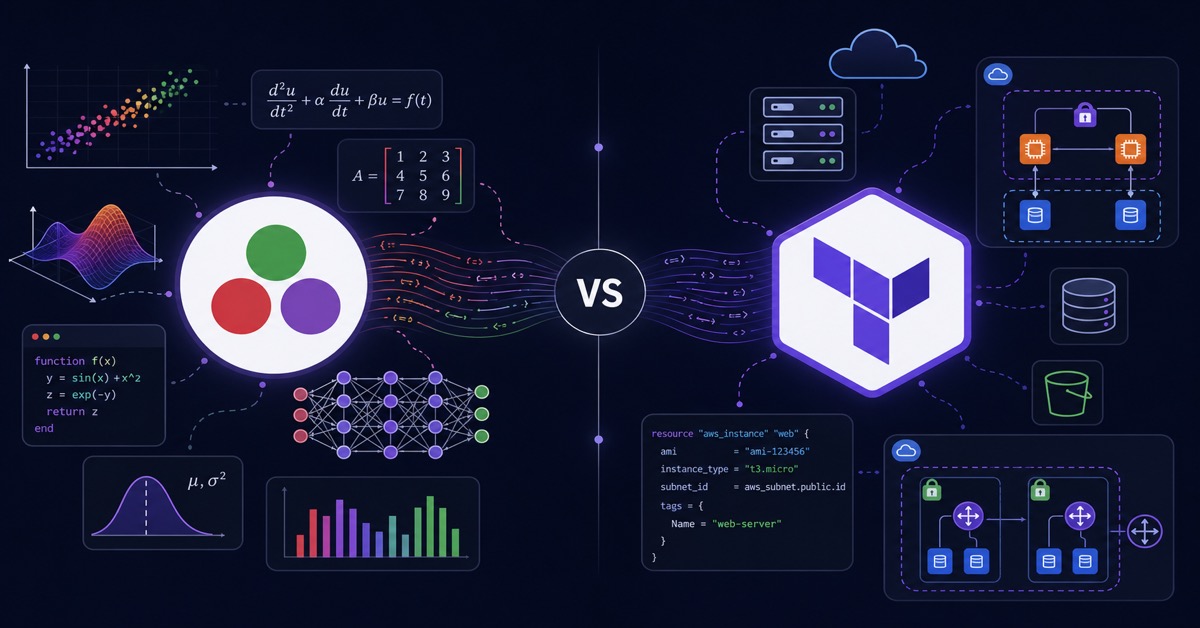
For a deeper comparison of how Terraform relates to other tools in the ecosystem, see our article on Julia vs Terraform - which clarifies the distinction between programming languages and infrastructure tools.
Kubernetes and microservices on AWS
Microservices break a monolithic application into independently deployable services, each owning a specific business function. On AWS, you run them as containers orchestrated by Kubernetes - typically through Amazon EKS (Elastic Kubernetes Service). If you are new to Kubernetes concepts, our practical introduction to Kubernetes covers pods, deployments, services, and autoscaling from the ground up.
Why microservices with Kubernetes work well together:
Independent scaling. A payment processing service handling Black Friday traffic scales separately from the user profile service running at baseline load. You pay only for the compute each service actually needs.
Technology flexibility. One service runs Go for performance-critical path processing. Another runs Python for ML inference. Kubernetes does not care - it manages containers regardless of what runs inside them.
Fault isolation. A memory leak in one service does not take down the entire platform. Kubernetes restarts the failed pod while other services continue operating.
Zero-downtime deployments. Rolling updates, blue-green deployments, and canary releases are native Kubernetes capabilities. New versions go live without user-facing interruptions.
For a detailed comparison of managed Kubernetes options, see our EKS vs GKE analysis for regulated workloads.
What Kubernetes provides at the orchestration layer
Kubernetes handles the operational complexity that makes microservices viable at scale:
- Automated bin-packing - places containers on nodes to maximize resource utilization
- Service discovery and load balancing - internal DNS resolves service names, traffic distributes automatically
- Self-healing - restarts failed containers, replaces unresponsive nodes, kills containers that fail health checks
- Horizontal pod autoscaling - adds or removes replicas based on CPU, memory, or custom metrics
- Config and secret management - injects environment-specific configuration without rebuilding containers
- Rolling updates with rollback - deploys new versions incrementally, automatically rolls back on failure
The reference architecture: AWS + Terraform + EKS
Here is the architecture pattern we implement for production workloads. Each component is provisioned and managed through Terraform:
Networking (VPC)
- Multi-AZ VPC with public and private subnets
- NAT Gateways for outbound internet access from private subnets
- VPC endpoints for S3, ECR, and other AWS services (reduces data transfer costs)
- Network ACLs and security groups following least-privilege principles
Compute (EKS)
- Managed EKS control plane (AWS handles the Kubernetes API server)
- Managed node groups with autoscaling (Karpenter or Cluster Autoscaler)
- Spot instances for non-critical workloads (60-90% cost savings)
- Fargate profiles for burst workloads that do not justify dedicated nodes
Data layer
- RDS PostgreSQL or Aurora with Multi-AZ failover
- ElastiCache Redis for session storage and caching
- S3 for object storage with lifecycle policies
- Secrets Manager for database credentials and API keys
Observability
- CloudWatch Container Insights for EKS metrics
- Application-level metrics exported to Prometheus + Grafana
- Centralized logging with Fluent Bit shipping to CloudWatch Logs or OpenSearch
- Distributed tracing with AWS X-Ray or OpenTelemetry
CI/CD
- GitHub Actions or AWS CodePipeline for build and deploy
- ECR for container image storage
- ArgoCD or Flux for GitOps-based Kubernetes deployments
- Terraform runs in CI with plan on PR, apply on merge

Architecture principles from AWS Well-Architected
We align every architecture with the AWS Well-Architected Framework pillars. For this Terraform + EKS stack, the key decisions map as follows:
Operational Excellence - Infrastructure as code with Terraform. GitOps for Kubernetes deployments. Runbooks for common failure scenarios. Everything documented, nothing tribal.
Security - IAM roles for service accounts (IRSA) so pods get fine-grained AWS permissions without static credentials. Network policies between namespaces. Encryption at rest and in transit by default.
Reliability - Multi-AZ everything. Pod disruption budgets prevent scaling events from taking down services. Health checks at both container and application levels.
Performance Efficiency - Right-sized node groups. Horizontal pod autoscaling based on application metrics, not just CPU. Spot instances for fault-tolerant workloads.
Cost Optimization - Spot instances, Savings Plans for baseline compute, S3 lifecycle policies, right-sizing based on actual utilization data. Regular cost reviews to catch waste early.
The point of distributed architecture ownership is that every team building on this reference architecture understands why each decision was made. We document these as Architecture Decision Records (ADRs) alongside the Terraform code.
How we implement this for clients
A typical engagement to build or migrate to this architecture follows a predictable path:
- Discovery (1 week) - understand current state, requirements, constraints, compliance needs
- Architecture design (1-2 weeks) - Terraform module structure, networking design, EKS configuration, security model
- Implementation (2-4 weeks) - Terraform code, CI/CD pipelines, first service deployment, observability setup
- Migration (varies) - move existing workloads to the new infrastructure, service by service
- Handover (1 week) - documentation, runbooks, knowledge transfer, support transition
For details on how this fits into a broader engagement, see what an AWS DevOps consulting engagement looks like in practice.
Conclusion
The combination of AWS, Terraform, and Kubernetes is not novel - it is the industry standard for a reason. The value is not in choosing these tools but in implementing them correctly: proper module structure in Terraform, right-sized EKS clusters, security built into the foundation rather than bolted on after, and CI/CD that makes deployments boring.
If your team is running infrastructure manually, fighting environment inconsistencies, or hitting scaling limits with a monolithic deployment, this pattern gives you a clear path forward. The architecture scales from a single service to hundreds, and the Terraform foundation means you can reproduce or modify it without starting from scratch.

Need help designing your AWS architecture?
We design and implement production-ready infrastructure with Terraform and EKS. Book a free 30-minute call to discuss your scaling challenges.


![CI/CD Consulting Services: Scope, Pricing & When to Hire a Consultant [2026]](/img/blog/post/2026-06-30/1200x628.jpg)

